

In France, industrial operators generating aqueous effluents face an increasingly stringent regulatory framework. Between ICPE requirements, sector-specific ministerial orders, special discharge agreements and changes arising from the European Industrial Emissions Directive (IED), identifying the discharge limits that actually apply is not always straightforward.
Misinterpreting these requirements can lead to non-compliance, additional treatment costs and even administrative penalties. The challenge is compounded by the fact that several regulations may apply simultaneously to the same industrial site, sometimes covering the same parameters.
This article provides an overview of the main rules governing industrial wastewater discharges and the criteria that must be considered to ensure regulatory compliance.
Key points at a glance:
- Several regulations may apply simultaneously to the same discharge.
- The strictest limit value generally applies.
- Both concentrations and pollutant loads are regulated.
- Requirements vary according to the discharge point, including the characteristics of the receiving water body or municipal wastewater treatment plant.
- Heavy metals are among the pollutants most closely monitored by environmental authorities.
What Regulations Govern Industrial Wastewater?
Industrial wastewater regulations are based on several levels of legislation and regulatory requirements, which may apply cumulatively.
ICPE Requirements
Installations Classified for Environmental Protection (ICPE) form the regulatory basis for many industrial sites in France. Depending on their activities and the relevant ICPE classification headings, operators must comply with emission limit values set by ministerial orders or by their site-specific prefectural operating permit.
The emission limit values set out in an operating permit are established “taking into consideration the characteristics of the installation concerned, its geographical location and local environmental conditions.”
These requirements define, in particular, the maximum permissible concentrations of various pollutants, including heavy metals present in wastewater.
Sector-Specific Ministerial Orders
Some industrial sectors are subject to specific ministerial orders that supplement or reinforce the general ICPE requirements. These regulations may introduce specific limits for certain parameters or require more extensive monitoring procedures.
The IED and European BREF Documents
For the largest industrial facilities, the Industrial Emissions Directive (IED) requires the implementation of Best Available Techniques (BAT).
BAT conclusions published at the European level define the environmental performance levels that operators must achieve. During periodic reviews of operating permits, discharge limits may be revised to align with these requirements.
INERIS provides guidance on implementing the IED, together with resources covering BAT conclusions and emission load inventories: IED guidance and BAT conclusions (AIDA-INERIS).
Special Discharge Agreements
When an industrial operator discharges wastewater into a public sewer system, it must generally obtain a discharge authorisation and, depending on the circumstances, enter into a Special Discharge Agreement with the relevant local authority.
Unlike direct discharge into the natural environment, the primary objective is to ensure that the effluent is compatible with the operation of the municipal wastewater treatment plant. Local authorities assess the nature of the pollutants, the volumes discharged, pollutant loads and the plant’s ability to absorb the additional load. They also ensure that industrial wastewater does not account for the majority of the flows entering their treatment plants.
A Special Discharge Agreement may impose additional requirements beyond those established under ICPE regulations, including discharge limits, maximum authorised pollutant loads, self-monitoring frequency and monitoring procedures. Pollution coefficients may also be applied to the discharged concentrations, directly affecting the price per cubic metre of wastewater sent to the public sewer system.
Heavy metals in wastewater often receive particular attention to prevent their accumulation in sewage sludge and protect the performance of biological treatment processes. Excessive metal concentrations in sludge can also make its recovery through agricultural land application impossible.
Finally, compliance is not based solely on discharge limits. The volumes discharged, pollutant loads and quality of the monitoring implemented by the operator also play an important role. In practice, local authorities generally favour a transparent, continuous-improvement approach with industrial operators while retaining the option to tighten requirements or increase charges in the event of repeated non-compliance.
Why Can an Industrial Operator Be Subject to Several Discharge Limits?
One of the main challenges encountered in practice is the overlap between regulatory requirements.
Consider, for example, a site subject to:
- the amended ICPE Ministerial Order of 26 November 2012;
- a specific sectoral order;
- a Special Discharge Agreement.
The same parameter, such as nickel, chromium or zinc, may be regulated by each of these documents, with different limit values.
In such cases, the operator must generally apply the most stringent value to ensure overall compliance.
This approach is particularly important for heavy metals in wastewater, whose environmental and health impacts are subject to increased scrutiny.
Concentration or Pollutant Load: An Essential Distinction
A common mistake is to consider only discharge concentrations, which are generally expressed in mg/L.
However, regulations may also set limits on the pollutant loads discharged, expressed in g/day, kg/day or tonnes/year.
Two industrial operators may have exactly the same zinc concentration in their effluent while generating very different environmental impacts, depending on the volumes discharged.
This is why many regulatory requirements simultaneously establish:
- a maximum concentration;
- a maximum daily pollutant load;
- and, in some cases, a maximum annual load.
The purpose is to limit not only the pollutant concentration at a given time but also the total quantity of pollution released into the environment.
The methods used to calculate pollutant loads and account for the loads that can be accepted by the receiving environment are detailed in the technical guidance on incorporating the objectives of the Water Framework Directive.
Discharge into the Natural Environment or the Public Sewer System: What Are the Differences?
The final destination of wastewater has a significant influence on the applicable regulatory requirements, although both discharge routes may be subject to stringent limits.
Direct Discharge into the Natural Environment
When an industrial operator discharges its effluent into a river, stream, lake or the marine environment, the applicable limits are generally the most stringent.
The objective is to directly protect aquatic environments and ensure compliance with the objectives established by the Water Framework Directive.
The authorities therefore consider:
- the concentrations discharged;
- pollutant loads;
- potential impacts on the receiving environment.
Regarding the latter, significant differences in discharge requirements may be observed. A small stream has a lower capacity to receive pollutant loads than a large river. Similarly, discharging upstream of a major urban area is generally subject to fewer constraints than discharging downstream.
In some cases, the receiving environment may already be considered saturated. Discharge requirements can then become extremely stringent, approaching the detection limits of laboratory analytical equipment.
Discharge into a Public Sewer System
When effluent is sent to a municipal wastewater treatment plant, regulatory constraints follow a different rationale.
The main objectives are to:
- protect wastewater collection infrastructure;
- prevent the inhibition of biological treatment processes;
- limit the accumulation of non-biodegradable pollutants in sewage sludge;
- preserve the performance of the wastewater treatment plant.
The limits imposed under a Special Discharge Agreement may therefore be more stringent than those established by certain ICPE ministerial orders. Local authorities also ensure that industrial effluent does not account for the majority of the volumes treated by the plant.
In all cases, the industrial operator must reach an agreement with the local authority. Otherwise, its wastewater discharge may be refused.
The conditions governing connection to a municipal wastewater treatment plant and the requirements applicable to sewerage systems are established by the French Ministerial Order of 21 July 2015 on collective sewerage systems.
Quels polluants sont les plus surveillés dans les eaux usées industrielles ?
Which Pollutants Are Most Closely Monitored in Industrial Wastewater?
The parameters monitored depend on the industrial activity concerned. Common parameters include pH, conductivity, temperature, total suspended solids, chemical oxygen demand, biochemical oxygen demand, total nitrogen, ammonium, total phosphorus, hydrocarbons, heavy metals, adsorbable organically bound halogens, solvents, volatile organic compounds and other priority hazardous substances.
INERIS published a study entitled “Hazardous substances for the aquatic environment in industrial discharges – Summary of initial monitoring results”. It includes a valuable resource for industrial operators: an appendix presenting detailed results by industrial sector from the French programme for monitoring hazardous substances in water.
This document can be used to identify the priority hazardous substances associated with each industrial sector.
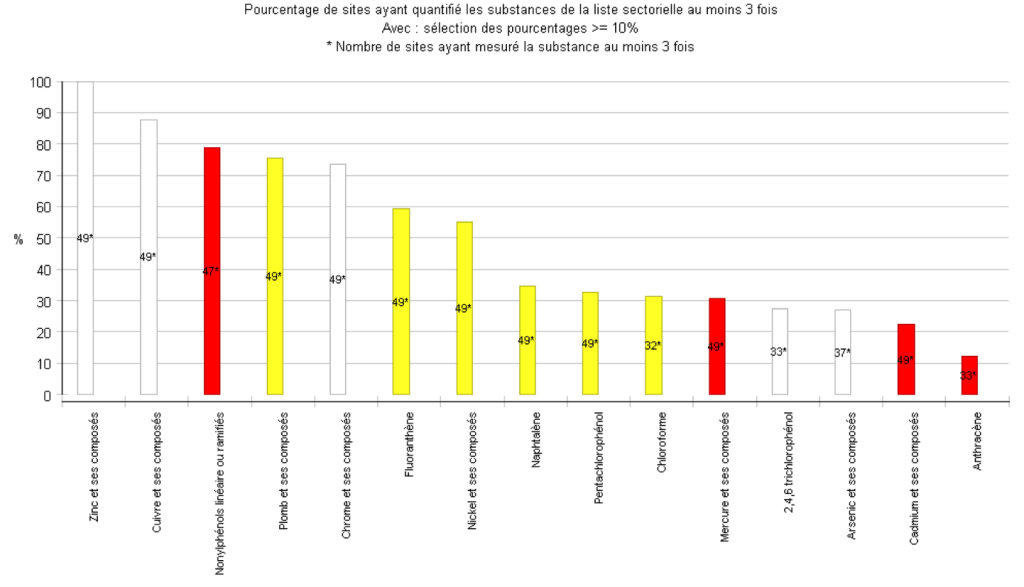
How to read the graph: for zinc, 49 sites tested their effluent for zinc at least three times, and 100% of these sites detected it on at least three occasions. For naphthalene, 49 sites tested their effluent at least three times, and 35% of them detected it on at least three occasions.
Certain metals are regularly covered by regulatory requirements:
- Zinc (Zn)
- Copper (Cu)
- Cadmium (Cd)
- Lead (Pb)
- Total chromium (Cr) and hexavalent chromium (Cr VI)
- Nickel (Ni)
- Mercury (Hg)
- Arsenic (As)
Monitoring these substances aims to limit their accumulation in aquatic ecosystems and their transfer into food chains.
For industrial operators, these requirements often involve implementing a comprehensive industrial water treatment strategy combined with regular analytical monitoring.
How Can Long-Term Regulatory Compliance Be Ensured?
Regulatory compliance cannot be reduced to a one-off inspection. Industrial operators must implement a continuous approach that includes:
- self-monitoring of regulated discharge parameters using rapid test kits or laboratory analyses;
- monitoring of discharged pollutant loads;
- regulatory monitoring of Best Available Techniques;
- anticipating future regulatory developments.
In many cases, regulatory developments are gradually leading to more stringent environmental requirements, particularly for priority hazardous substances and micropollutants.
For sites facing challenges related to the removal of heavy metals from wastewater, it is therefore essential to adopt a comprehensive approach that considers both treatment performance and future regulatory constraints.
Conclusion
Industrial wastewater regulations are currently based on a set of complementary regulatory instruments that may apply simultaneously to the same site. ICPE ministerial orders, sector-specific requirements, Special Discharge Agreements and European requirements must be assessed together to identify the discharge limits that actually apply.
Beyond concentrations, discharged pollutant loads also play a major role in assessing environmental compliance. This is particularly important for heavy metals in wastewater, whose impacts on aquatic environments are receiving increasing attention from the authorities.
Would you like to assess your regulatory constraints, compare several applicable limits or better understand how to remove heavy metals from your industrial process water? Read our article on water treatment solutions for trace metals, download our technical brochure or contact our team directly to discuss your situation.