
Chromium in industrial wastewater cannot be treated effectively without first identifying its chemical form. Hexavalent chromium, or Cr(VI), generally needs to be reduced to trivalent chromium, or Cr(III), before it can be efficiently removed by precipitation. When this process leaves a low concentration of dissolved chromium, a polishing treatment may be added downstream.
Selecting the right treatment train therefore requires answers to four questions: which form of chromium is present, at what concentration, in what type of water matrix and with what discharge objective? This initial characterisation helps prevent the selection of an unsuitable process or the under-sizing of a critical treatment stage.
Trivalent or hexavalent chromium: why speciation matters
Chromium can exist in several oxidation states, but two forms are particularly important in industrial wastewater treatment:
- trivalent chromium, Cr(III);
- hexavalent chromium, Cr(VI).
The distinction is essential because these two forms do not have the same mobility, toxicity or chemical behaviour. As a result, they require different treatment strategies.
Trivalent chromium: Cr(III)
In water, Cr(III) may be present as a dissolved cation, associated with hydroxides, attached to suspended particles or complexed by organic and inorganic ligands.
Under suitable pH conditions, Cr(III) can form chromium hydroxide precipitates. Conventional treatment therefore generally includes:
- pH adjustment;
- chromium hydroxide precipitation;
- coagulation and flocculation;
- settling, flotation or filtration.
This approach is well suited to removing a significant chromium load. However, residual dissolved chromium may remain when the operating conditions are not optimal, when the chromium is complexed, or when the discharge target is below the practical limit of conventional precipitation.
Hexavalent chromium: Cr(VI)
Cr(VI) is generally present in water as chromate or dichromate anions. It is typically more mobile and more toxic than Cr(III). Hexavalent chromium compounds are also recognised as a major health concern, particularly in occupational exposure contexts, as described in the OSHA overview of hexavalent chromium.
Simply increasing the pH is usually not sufficient to remove Cr(VI). The standard treatment sequence is generally based on two main stages:
- reduction of Cr(VI) to Cr(III);
- precipitation and separation of the resulting Cr(III).
The reduction stage may use reagents such as ferrous salts, sodium bisulphite or other reducing agents, depending on the water chemistry and operating conditions. The required reaction pH, contact time and reagent dosage must be validated for the actual wastewater.
A detailed description of the principles governing reducing agents and chromium reduction is available in the SUEZ Water Handbook technical resource on reduction processes.
Total chromium, dissolved chromium and chromium speciation
A total chromium measurement alone does not indicate:
- the proportion of Cr(III) and Cr(VI);
- whether the chromium is dissolved, colloidal or particulate;
- whether it is free or bound to complexing agents.
A useful analytical assessment may therefore include:
- total chromium in the untreated sample;
- Cr(VI), using an appropriate analytical method;
- dissolved chromium after filtration according to an agreed protocol;
- pH, suspended solids and conductivity;
- other metals, salts and potential complexing agents.
This distinction directly affects the treatment strategy. Particulate chromium may primarily require improved solid–liquid separation, whereas dissolved chromium usually requires a chemical reaction, a selective material or a membrane process.
What are the main industrial sources of chromium in water?
Chromium pollution in water is mainly associated with activities that use chromium compounds, process alloys or handle chromium-containing raw materials.
The industrial sectors most commonly concerned include:
- surface treatment and electroplating;
- metal finishing and metalworking;
- steel and stainless-steel production;
- leather tanning;
- pigment, dye and chemical manufacturing;
- mining and hydrometallurgical activities;
- waste, ash and industrial residue management;
- construction or drainage water in contact with concrete, backfill or contaminated soil.
Environment and Climate Change Canada identifies metal finishing, steel production, leather tanning, wood preservation and base-metal processing among the activities associated with chromium releases into the environment. Further information is available on its dedicated page about hexavalent chromium compounds and their industrial sources.
Within an industrial site, chromium may enter the wastewater system through several pathways:
- rinsing water;
- process bath purges;
- equipment and surface washing;
- the leaching of waste or residues;
- contaminated stormwater runoff;
- historical soil or groundwater contamination.
Identifying the source is important because segregating a concentrated stream is often more effective than treating it after dilution into the site’s entire wastewater flow.
Image caption: Chromium pollution in water is mainly associated with activities that use chromium compounds, process alloys or handle chromium-containing raw materials.
What are the environmental and operational risks?
The risks associated with chromium depend strongly on its chemical form. Cr(VI) generally raises the greatest concern because of its mobility and toxicity. A release may affect surface water, groundwater, aquatic organisms and, depending on the exposure pathway, human health.
Chromium is not biodegraded in the same way as an organic compound. It may instead:
- change oxidation state;
- precipitate;
- bind to particles;
- accumulate in sludge or sediment;
- migrate in dissolved form.
Reducing Cr(VI) to Cr(III) lowers the hazard associated with hexavalent chromium, but it does not remove the total chromium from the water. The resulting Cr(III) still needs to be precipitated, separated or immobilised.
For industrial operators, insufficiently controlled chromium treatment can also cause:
- non-compliant discharges;
- production restrictions or shutdowns;
- increased sludge production;
- high chemical consumption;
- operational instability;
- higher waste-management costs.
The assessment should therefore consider both chromium concentration and pollutant load, as well as the stability of treatment performance over time.
Which regulations apply to chromium discharges?
There is no single discharge limit that applies to every industrial site in France or across Europe. The applicable requirement depends on several factors, including:
- the industrial activity;
- the type of receiving environment;
- whether the water is discharged directly into the environment or into a public sewer;
- the site’s operating permit;
- the applicable Best Available Techniques conclusions;
- local discharge agreements and requirements.
A regulatory document may specify a limit for total chromium, Cr(VI), or both. It may also impose a concentration limit, a daily pollutant load, a monitoring frequency or a combination of these criteria.
The INERIS chromium substance portal provides substance-specific regulatory and physicochemical information relevant to the French context.
Before designing or upgrading a treatment system, industrial operators should verify:
- the limit stated in the site’s prefectural order or operating permit;
- the requirements of any wastewater discharge agreement;
- the sampling point and monitoring frequency;
- the chromium form covered by the analysis;
- whether compliance is assessed by concentration, load or both.
For a broader overview, BIOHAP has also published an article on industrial wastewater regulations and discharge requirements.
How can chromium be removed from industrial wastewater?
The most suitable process depends on chromium speciation, concentration, flow variability, the water matrix and the required discharge target.
1. Segregating streams and reducing pollution at source
Before adding a treatment stage, it is useful to determine whether chromium-bearing streams can be isolated.
Possible measures include:
- separating concentrated process baths from dilute rinsing water;
- optimising rinsing operations;
- extending bath life;
- preventing contact between clean stormwater and contaminated areas;
- reducing unnecessary water use;
- recovering chromium from concentrated streams where technically and economically relevant.
Source reduction can lower reagent consumption, sludge production and the overall treatment cost.
2. Reducing Cr(VI) to Cr(III)
When hexavalent chromium is present, reduction is usually the first essential treatment stage.
The effectiveness of this reaction depends on:
- the reducing agent;
- pH;
- contact time;
- temperature;
- mixing conditions;
- competing oxidants;
- the initial Cr(VI) concentration.
The residual Cr(VI) concentration must be monitored to confirm that the reduction reaction is complete before the precipitation stage.
3. Precipitating and separating Cr(III)
Once chromium is in the trivalent form, pH adjustment can promote the formation of chromium hydroxide.
The precipitated solids must then be separated using a suitable process, such as:
- coagulation–flocculation;
- clarification;
- lamella settling;
- dissolved air flotation;
- filtration;
- membrane filtration.
This stage removes most of the chromium load when the water chemistry and operating parameters are properly controlled.
4. Removing residual dissolved chromium
A polishing stage may be needed when conventional precipitation does not consistently achieve the required limit.
Possible polishing technologies include:
- ion-exchange resins;
- membrane processes;
- adsorption media;
- reactive mineral media;
- electrochemical processes;
- combined treatment trains.
Each solution has different requirements in terms of selectivity, operating cost, maintenance, waste production and sensitivity to the water matrix. BIOHAP provides a more detailed comparison in its article on water treatment solutions for trace metals.
Why can chromium remain after physicochemical treatment?
The presence of residual chromium does not necessarily mean that the overall treatment principle is unsuitable. It may result from a specific operational or chemical limitation.
Common causes include:
- unstable or inappropriate pH;
- insufficient reaction time;
- rapid variations in flow or chromium concentration;
- the presence of complexing agents;
- poor coagulation or flocculation;
- fine particles or colloids that are difficult to separate;
- incomplete reduction of Cr(VI);
- a discharge target below the practical limit of conventional precipitation.
The first step is to determine whether the residual chromium is particulate, colloidal or genuinely dissolved.
If the residual fraction is mainly particulate, improving clarification or filtration may be sufficient. If it is dissolved, an additional chemical or selective capture process will generally be required.
Which treatment should be selected?
| Observed situation | Main treatment | Possible polishing stage |
|---|---|---|
| Cr(VI) is predominant | Reduction to Cr(III), followed by precipitation | Removal of residual Cr(III) |
| Cr(III) is present at high concentration | Precipitation and solid–liquid separation | Specialised media or ion exchange |
| Dissolved Cr(III) is present at low concentration | Polishing treatment | Reactive mineral media or ion exchange |
| Effluent composition is highly variable | Equalisation and controlled physicochemical treatment | Downstream safety barrier |
| Water reuse is required | Multi-barrier treatment train adapted to the matrix | Membrane or combined processes |
The final choice should also consider:
- average and peak flow rates;
- chromium load;
- the presence of other metals;
- suspended solids;
- salinity;
- complexing agents;
- sludge-management requirements;
- reagent consumption;
- available space;
- the required level of operational supervision.
Laboratory or pilot testing using real wastewater is generally recommended before selecting a full-scale solution.
What role can reactive mineral media play?
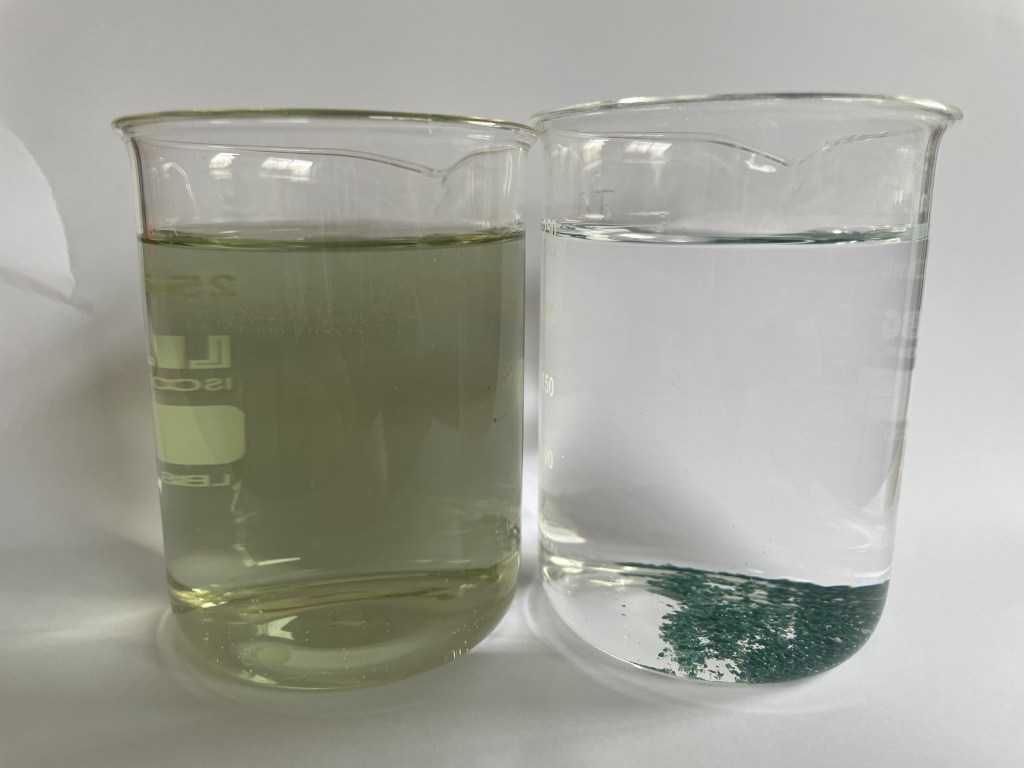
Reactive mineral media can be used to capture trivalent chromium remaining after the main physicochemical treatment. They are particularly relevant when the objective is to remove a low residual concentration before discharge or water reuse.
BIOHAP develops apatite-based materials designed to immobilise residual metallic pollutants. In a chromium treatment train, these materials are not intended to replace the reduction of Cr(VI). They are positioned downstream to treat:
- Cr(III) initially present in the wastewater;
- Cr(III) produced by the reduction of Cr(VI);
- residual dissolved chromium remaining after precipitation and separation.
The use of a BIOHAP granular apatite solution may provide a polishing barrier for industrial wastewater containing low concentrations of residual trivalent chromium.
However, treatment performance depends on the actual water matrix. Suspended solids, competing ions, complexing agents, salinity and pH may all affect chromium availability and media performance.
Testing with representative wastewater is therefore essential. BIOHAP can carry out a treatability study using industrial wastewater to assess removal performance and help define the most suitable treatment configuration.
Which analyses are required before selecting a treatment?
A relevant characterisation programme should ideally include:
- total chromium;
- Cr(VI), where applicable;
- dissolved chromium after filtration according to an agreed protocol;
- pH;
- suspended solids;
- other metals;
- salts and process reagents;
- potential complexing agents;
- average and peak flow rates;
- operating cycles and discharge frequency;
- the target concentration and its regulatory basis.
A representative sample of actual wastewater is preferable to a synthetic solution. Real industrial water may contain compounds that significantly influence chromium speciation, precipitation and capture.
The objective is not only to demonstrate removal under ideal conditions, but to confirm that the treatment remains effective under realistic operating conditions.
Securing chromium removal with the right treatment train
Effective chromium treatment begins with proper characterisation of the wastewater. Cr(VI) and Cr(III) require different approaches: hexavalent chromium generally needs to be reduced before the resulting trivalent chromium can be precipitated and separated.
When conventional physicochemical treatment leaves a low residual concentration, a polishing process may help secure discharge compliance. Reactive mineral media can be considered for removing residual dissolved Cr(III), provided that their performance is validated using the actual industrial wastewater.
BIOHAP supports industrial operators, water-treatment companies and engineering firms in assessing metallic pollution and testing treatment solutions on representative samples.
Contact BIOHAP to discuss a chromium-contaminated wastewater stream or request a treatability study.
Frequently asked questions about chromium in industrial wastewater
What is the difference between Cr(III) and Cr(VI)?
Cr(III) is the trivalent form of chromium. Under suitable conditions, it can generally be precipitated as chromium hydroxide. Cr(VI) is the hexavalent form, which is typically more mobile and toxic. It generally needs to be reduced to Cr(III) before precipitation.
Can Cr(VI) be removed by direct precipitation?
Direct precipitation is generally not the preferred approach for Cr(VI). The conventional treatment sequence consists of reducing Cr(VI) to Cr(III), followed by precipitation and solid–liquid separation.
Why does chromium remain after precipitation?
Residual chromium may be caused by inappropriate pH, incomplete reactions, complexing agents, fine particles, colloids, poor solid–liquid separation or incomplete Cr(VI) reduction. A dissolved fraction may also remain when the target concentration is below the practical limit of the precipitation process.
Can filter media treat Cr(VI)?
This depends on the chemistry of the media and on performance demonstrated with the actual water matrix. BIOHAP apatite-based materials are positioned primarily for the capture of Cr(III). When Cr(VI) is present, a reduction stage is generally required before treatment with the mineral media.
What chromium discharge limit applies to an industrial site?
The applicable limit depends on the activity, discharge point, receiving environment and site-specific regulatory documents. Requirements may concern total chromium, Cr(VI), concentration, daily load or several of these parameters. The site’s operating permit and wastewater discharge agreement should therefore be checked before defining the treatment objective.